 Strategies to Expand Housing Access for Low-and Middle-Income Households in Southern Arizona
Executive Summary
Housing affordability has become an increasingly pressing challenge in Southern Arizona, particularly in Tucson. Home prices and population growth have outpaced local income gains, making it more difficult for both low- and middle-income households to find housing they can afford. Lower-income residents rely on assistance programs, while median-income households are priced out of the local housing market.
The report identifies three primary drivers of Tucson’s housing affordability crisis: constrained housing supply, in-migration from higher-cost states, and neighborhood-level demand. Overall, housing supply has not kept pace with demand, while desirable neighborhoods have experienced rising demand and median-income residents have been priced out, further restricting access to affordable options.
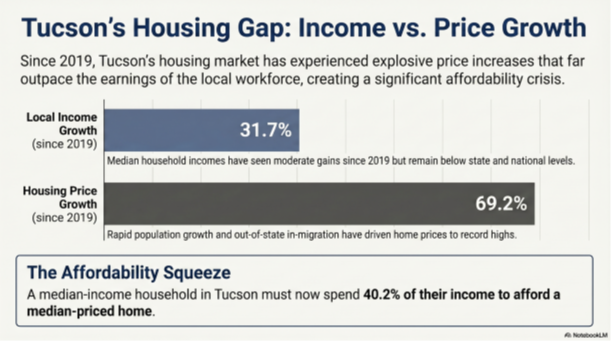
As Figure 1 illustrates, the gap between income growth and housing price growth has widened considerably. Since 2019, Tucson’s median household income has increased by 31.7%, while housing prices have risen by 69.2%. A household earning the median income would need to spend 40.2% of its income to afford a median-priced home.
Figure 1: Tucson’s Housing Gap: Income vs. Price Growth.
The report reviews best practices from peer cities, including Albuquerque, San Antonio, El Paso, and Las Vegas, to identify strategies for increasing housing supply and reducing barriers to affordable housing development.
Policy Recommendations
These recommended strategies dive into several different options that Tucson could implement as a way to seek positive change in its housing affordability landscape.
- Cross-Sector Collaboration: Through coordinated cross-sector collaboration, public, private, and nonprofit actors play complementary roles in reducing regulatory, financing, and development barriers while ensuring that community needs are met. Expanding this approach to include mission-driven financial institutions, such as credit unions, could further close homeownership gaps and create scalable, inclusive housing solutions through targeted lending programs for middle-income households.
- Zoning Reform: State and local zoning reforms could expand development flexibility by enabling inclusionary zoning, increasing density, and reducing costly regulations such as parking mandates. Together, these changes could increase housing supply, support “missing middle” households, and promote more equitable, mixed-income communities.
- Targeted Use of the Low-Income Housing Tax Credit (LIHTC): Strategic use of Low-Income Housing Tax Credit allocations can support both low-income and workforce housing. This approach can assist middle-income households increasingly displaced by higher-income in-migrants. By prioritizing developments serving households earning 80% to 120% of area median income (AMI) in competitive areas, the state can expand housing access, stabilize the local workforce, and fill critical gaps that the market alone cannot address.