 Examine Early Education Enrollment Rates in Tucson, Arizona MSA
How are we doing?
Share of Those Aged 3-and-4 that Attend an Early Education Program (2024)
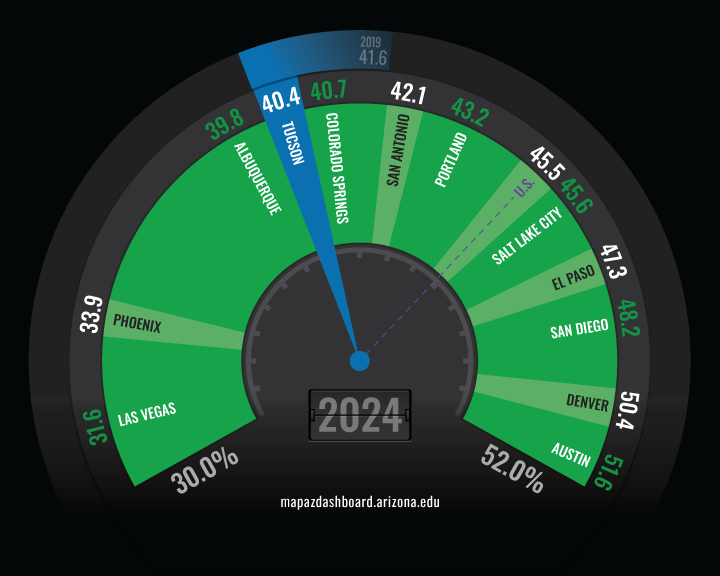
In 2024, the Tucson Metropolitan Statistical Area (MSA) ranked below the middle of the pack among peer MSAs in the share of three- to four-year-olds enrolled in an early education program at 40.4%. Austin ranked first at 51.6%, while Las Vegas ranked last at 31.6%. Among all school-age children in Tucson, 87.8% attended public institutions. That share was slightly below Arizona but consistent with the national average. In 2023, 23.7% of all public schools in Arizona were charter schools, well above the U.S. rate of 8.0%.
Why is it important?
Families have multiple options for their child’s education, including public, private, and charter schools, as well as early education programs. Enrollment in early education programs has increased over time and is associated with stronger kindergarten readiness, including early literacy, foundational math skills, vocabulary development, and social skills. Enrollment rates in early education programs vary widely by income and other demographic factors, as do public and private school attendance rates. Over the past two decades, charter schools have expanded rapidly and now represent a large share of public school options in many states, particularly in Arizona.
How do we compare?
In 2024, 87.3% of school-age children in the U.S. attended public schools, while 12.7% attended private schools. The public school attendance rate was slightly higher in Tucson and Arizona at 87.8% and 89.0%, respectively. It is important to note that homeschooled children may be counted in the private school category in Census Bureau data, while charter schools are classified as public schools.
Charter schools are independent public schools that operate outside the regulations imposed on school districts. Charter schools are accountable to their individual charter, issued by the state, county, or district. The first charter school in the U.S. opened in 1992. The share of charter schools has significantly expanded over the past two decades. Since 2000, Arizona has led the 10 western states in the share of public schools that are charter schools. In 2023, charter schools accounted for 23.7% of all public schools in Arizona. Colorado was a distant second at 13.9%, while Washington reported just 0.6%.
How is it measured?
Data on early education enrollment and public/private school attendance are from the Census Bureau’s American Community Survey (ACS) five-year estimates. The ACS is a nationwide rolling sample survey that produces detailed demographic, social, housing, and economic data. Because five-year estimates reflect pooled data collected over five-years, they are comparable only across five-year intervals. National and state charter school data comes from the National Center for Education Statistics (NCES) Digest of Education Reports.